 The Romanesque of Burgundy - themes and programs, by Marcello Angheben, 560 pages, Brepols Publishers, Turnhout, Belgium.
 The doctoral thesis of Marcello Angheben - Lecturer in Art History at the University of Poitiers - was sustained in 1998 and expanded edition of the book was published in 2003. But the dates do not matter when a company such an interest.
Angheben Marcello invites us to follow him in the churches of Burgundy, not to carry out simple surveys, but to try to understand the intentions which led to the choice of themes for capitals. He managed to guide us with great erudition never tire the reader by an austere style, quite the contrary: it feels to read the same pleasure with Emile Male, Marcel Durliat, Jacques Fontaine, Jean-Maurice Rouquette, well others.
Marcello Angheben method is of great interest. He proposes to study the Romanesque Burgundy
referring to the representations made by themselves
(indications Graphic) - by linking them with the medieval texts he quotes extensively - but also from the point of view of syntax. And it is this latter methodology, little used to this thesis as regards the Roman capitals, which complement the previous, is the originality of his research and gives it an undeniable heuristic.
The syntax is designed as "the relationship between the theme and context in which it is built
. Should therefore pay attention instead of the theme in the building: near the entrance to the choir, in the ambulatory on the north side or south side, etc.. We must also consider "the environment iconographic an image. " Thus, in buildings where the theme of Daniel in the lions is associated with antithetic themes (images of torture, lust, etc..), It does not mean the same as where it is associated with other paradigms of spiritual warfare, such as Samson or David. And when these capitals are close to the altar, the representation of Habakkuk bringing bread to Daniel adds a Eucharistic dimension to the scene.
 In the first part, Marcello Angheben, considering the church as a symbolic space, analyzes the themes found on the capitals of the choir. In this place reserved
 clergy, we find images related to the idea of Paradise, Heavenly Jerusalem, but also the various representations
quaternities: author, based on its extensive knowledge of the texts, emphasizes the importance of the number four in the medieval symbolism. Themes are also analyzed pairs, Atlantis, angels, lions facing each other, eagles, Supper at Emmaus, the Kiss on the mouth, the release of St Peter.
In a second part, the most important, Mr. Angheben examines the design of the building medieval church as a place for a fight physical and spiritual. Here we encounter the capitals which are represented the threats posed by the attacks of evil
multifaceted and struggles against them: angels against demons, angels defenders souls, Samson, David, Daniel in the lions' den, Jonah, of men fighting monsters, fighting warriors, virtue triumphing over vice, fighting monks and hermits against the temptations (St. Benedict, St. Anthony, etc.).
In the last chapter of this part, the author examines the capitals which are represented
assault forces of evil without their face a "champion" of the property:
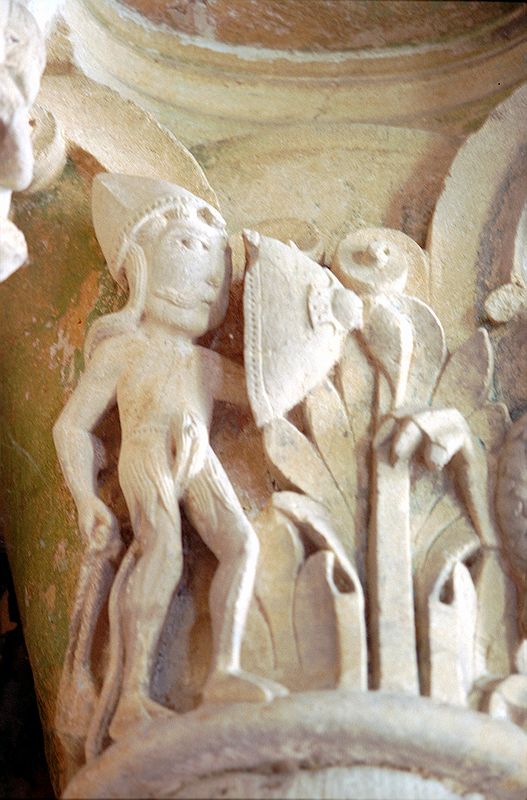
attacking animals or devils men, centaurs arrowhead, cockfighting, and also the strange fights Pilosi cons of three-headed birds. [The pilosus is a kind of hybrid warrior, wearing a kilt, wearing a helmet, carrying a shield and whose members are sometimes less than those of a man, sometimes those of an animal]. These capitals are mostly in the western part of the church, or in the peripheral space of the ambulatory and not in the choir.
The third part of the book consists of case studies to distinguish the churches in which significant associations with capitals are numerous enough that we can
speak of a true iconographic program.
The documentation is very rich: 151 photos, 43 drawings and an extensive bibliography.
This book, intended primarily for researchers, will also close the expectations of all lovers of Romanesque art. Hopefully, the method followed by Marcello Angheben, so clearly exposed, and if successful to understand the mentality that led to the choice of Graphic medieval clerics in Burgundy or adapted to other regions rich in capitals, as Auvergne Upper Poitou, etc.. When the two looking for a master, the wisest course is to explore the possibilities of design, and not be misled into fruitless ventures by confusing the difference with the cult of the authentic and rare originality. Marcello
Angheben seems to be such a master that we hope many students will follow the lesson.
Michel Claveyrolas


 Flux RSS


